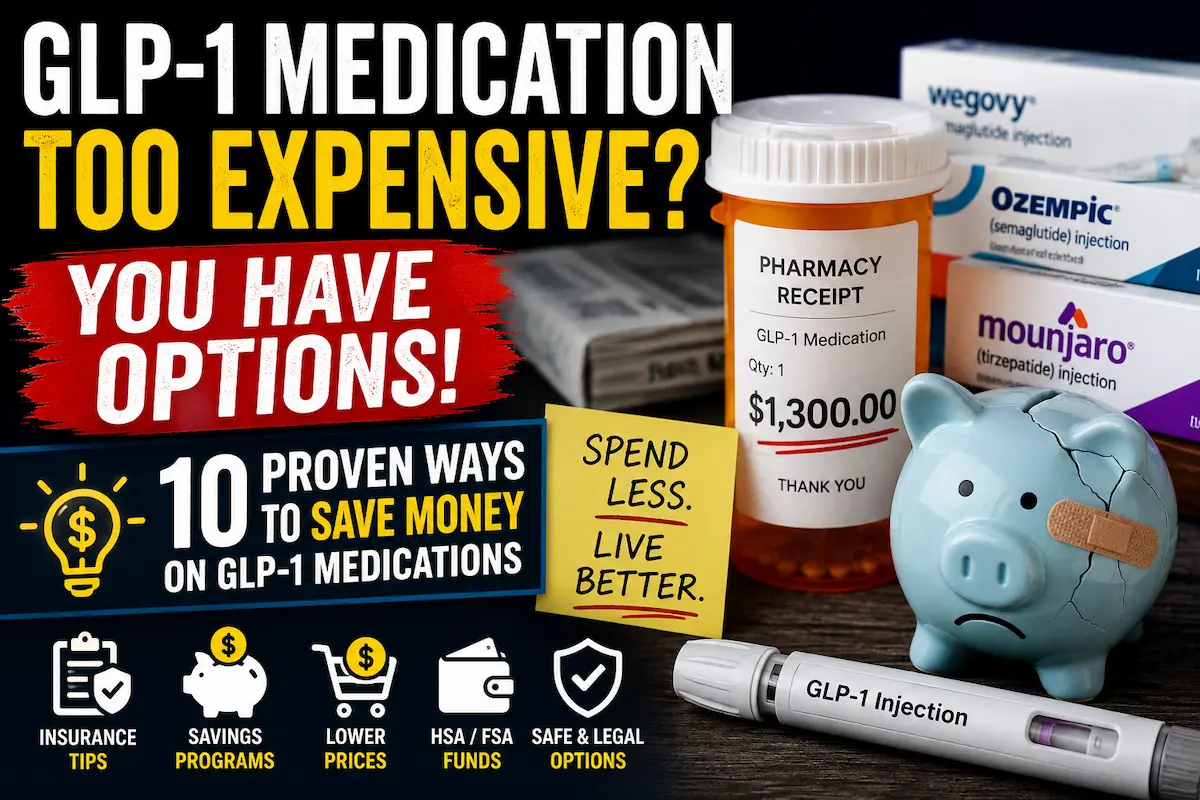
The price you first see for a GLP-1 medication may not be the price you ultimately have to pay. Coverage can depend on the medication's FDA-approved use, your diagnosis, your employer's plan, prior authorization requirements, deductible status, pharmacy network and eligibility for official assistance programs.
The goal of this guide is not to promise a particular price. It is to give you a practical process for uncovering legitimate savings opportunities while avoiding unsafe shortcuts.
Why are GLP-1 medications so expensive?
The cash price can reflect patent protection, manufacturer pricing, supply-chain costs, pharmacy contracts and the absence of insurance coverage for a particular use. Even people with insurance can face a deductible, coinsurance, formulary exclusion or prior authorization requirement.
That is why two people taking a similar medication may receive dramatically different bills. One may have employer coverage and a manufacturer card, while another may be paying the full cash price.
For a deeper explanation, read why GLP-1 medications can cost more than $1,300 per month .
Looking beyond prescription-only options?
Ignyt triGLP is marketed as a non-prescription wellness supplement, not as a substitute for Ozempic, Wegovy, Mounjaro, Zepbound or medical care. Review the ingredients, limitations and full comparison before deciding whether it fits your personal wellness goals.
View the official triGLP offer →1Review your insurance coverage carefully
Do not rely only on what appears at the pharmacy counter. Call your insurer and ask targeted questions. The difference between “not covered” and “additional information required” can be enormous.
- Is the exact medication on the current formulary?
- Is it covered for my diagnosis and prescribed use?
- Does the plan require prior authorization?
- Is step therapy required first?
- Is there a preferred GLP-1 medication on a lower tier?
- Which retail or mail-order pharmacies are preferred?
- Would a 90-day prescription reduce the cost?
- How much of my deductible remains?
Formularies and employer benefits can change from year to year. Recheck coverage during open enrollment rather than assuming next year's rules will remain the same.
2Check official manufacturer savings programs
Manufacturers currently advertise savings programs for several GLP-1 medications. These programs have eligibility rules, maximum savings limits and expiration dates. Commercially insured patients may be treated differently from uninsured patients, and government healthcare beneficiaries are commonly excluded from commercial savings cards.
| Medication | Official 2026 savings example | Important limitation |
|---|---|---|
| Wegovy | Official materials advertise prices as low as $25 monthly for some eligible commercially insured patients. | Eligibility, maximum savings and current terms apply. |
| Ozempic | Some eligible commercially insured patients with coverage may pay as little as $25. | Ozempic is indicated for type 2 diabetes and related approved uses, not specifically for weight loss. |
| Mounjaro | Some eligible commercially insured patients with coverage may pay as little as $25 for up to a three-month prescription. | Government beneficiaries are generally excluded from the commercial savings card. |
| Zepbound | Official programs include different commercial-insurance and self-pay options depending on presentation and dose. | Terms, refill limits, product form and expiration dates matter. |
3Compare prices at several pharmacies
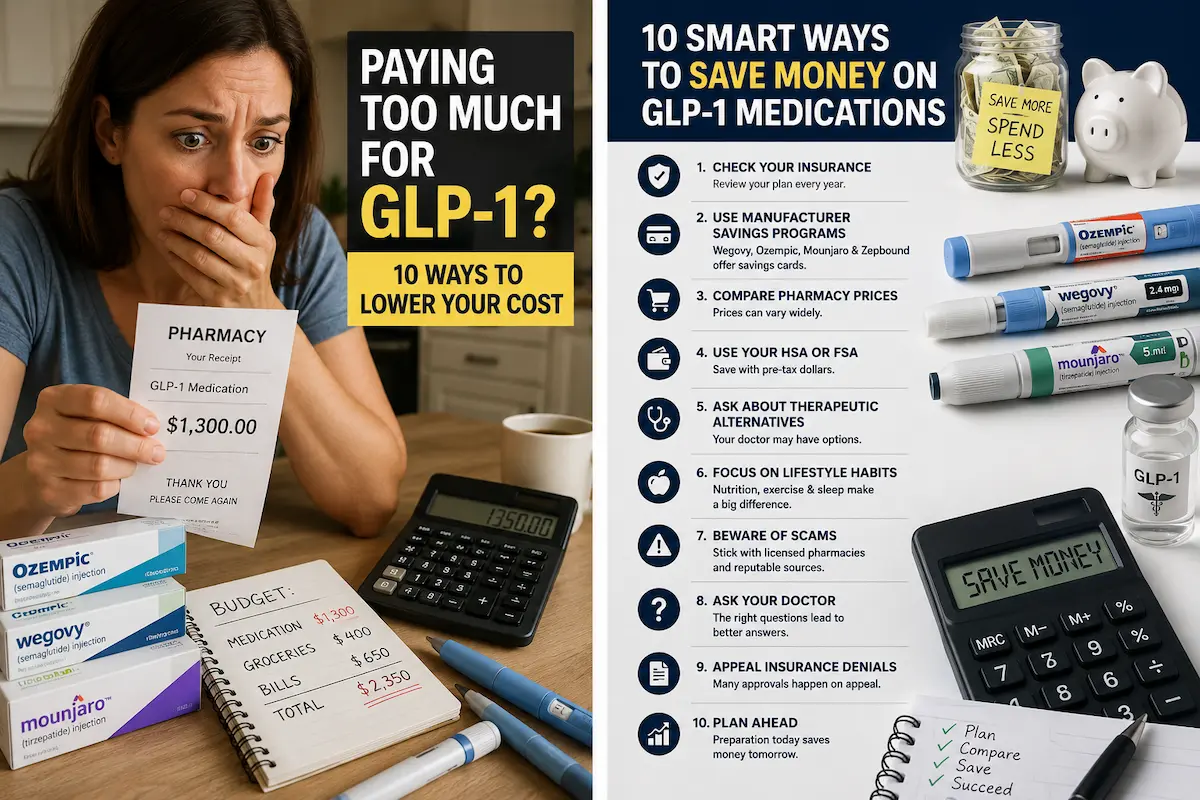
The same prescription may produce different prices at an independent pharmacy, a large chain, a warehouse club, a preferred-network pharmacy or your plan's mail-order service.
Ask each pharmacy to quote the cost using the same conditions. A cash price is not directly comparable to an insurance price if one counts toward your deductible and the other does not.
Compare these details—not only the number on the screen
- Price processed through your insurance.
- Cash price without insurance.
- Whether the pharmacy is preferred or out of network.
- Whether a discount program can be combined with insurance.
- Whether the expense counts toward your deductible or out-of-pocket limit.
- Shipping, membership or dispensing fees.
4Ask whether a longer prescription costs less
Some insurance plans and manufacturer savings programs may allow a two- or three-month fill. This can reduce repeated copays or improve the value of a savings card.
A longer fill may not be appropriate while a patient is changing doses or if the pharmacy, insurer or savings program does not allow it. Ask the prescriber, pharmacist and insurer before assuming it will save money.
5Appeal an insurance denial
A denial is not always the final answer. It may result from missing records, the wrong diagnosis code, a prior authorization requirement, incomplete documentation or a step-therapy rule.
A practical appeal process
- Request the exact written denial reason.
- Ask for the plan's medical-necessity and coverage criteria.
- Confirm that the diagnosis and medication request were submitted correctly.
- Ask your healthcare provider to supply the required clinical documentation.
- Document previous treatments, contraindications or unsuccessful attempts when relevant.
- Submit the appeal before the plan's deadline.
- Keep copies of every letter, form and reference number.
Your healthcare provider's office may already have a prior-authorization team or staff member who handles medication appeals.
6Use eligible HSA or FSA funds
Prescription medications purchased for qualified medical care are generally considered eligible medical expenses under federal tax rules when they are not reimbursed elsewhere. Using pre-tax HSA or FSA funds does not reduce the pharmacy's listed price, but it may reduce the effective after-tax cost.
7Discuss medically appropriate alternatives
Your prescriber may be able to discuss a different FDA-approved medication, a preferred formulary option or another evidence-based treatment strategy. The least expensive option is not automatically the right option; medical history, diagnosis, effectiveness, contraindications and side effects matter.
It is also important to distinguish medications approved for diabetes from those approved for chronic weight management. Insurance coverage may depend heavily on the indication.
You can compare related options in our triGLP vs. Ozempic and Wegovy guide and triGLP vs. Mounjaro and Zepbound guide.
8Review the 2026 Medicare GLP-1 Bridge program
Beginning July 1, 2026, Medicare provides eligible Part D beneficiaries access to certain GLP-1 medications through a temporary nationwide Medicare GLP-1 Bridge program.
Medicare states that eligible participants pay a $50 copayment for a one-month supply. Clinical eligibility requirements, a covered Part D plan, a prescription, lifestyle-program participation and prior authorization may apply.
Commercial manufacturer savings cards commonly exclude Medicare beneficiaries, so the Medicare program and Part D coverage should be evaluated separately.
9Avoid unsafe online and counterfeit products
A price that seems dramatically lower than every licensed pharmacy deserves scrutiny. The FDA has warned about counterfeit Ozempic, fraudulent compounded products and illegally marketed semaglutide and tirzepatide.
Compounded medications are not FDA-approved and do not undergo the same premarket review for safety, effectiveness and quality. The FDA advises that compounded drugs should generally be used only when a patient's medical needs cannot be met by an FDA-approved drug.
10Start the process before your next refill
Prior authorizations, appeals, transfers and savings-card approvals can take time. Waiting until the last injection or final dose increases the risk of an interruption.
- Check the number of doses remaining.
- Confirm whether the next dose strength will change.
- Request the refill early enough for authorization processing.
- Verify savings-program expiration dates.
- Confirm pharmacy inventory before transferring a prescription.
- Do not double doses or change your schedule to stretch medication without medical direction.
A simple GLP-1 cost-saving action plan
| When | Action | Who to contact |
|---|---|---|
| Today | Confirm formulary status, prior authorization and preferred pharmacies. | Your insurer |
| Today | Review the official manufacturer savings page. | Medication manufacturer |
| Within 24–48 hours | Compare insurance, cash and mail-order prices. | Licensed pharmacies |
| If denied | Request the written reason and begin the appeal. | Insurer and prescriber |
| Before the next refill | Confirm approval, inventory and final price. | Pharmacy |
Compare the full monthly commitment
When comparing a prescription medication with a non-prescription wellness product, do not compare price alone. Compare intended use, evidence, ingredients, safety, medical oversight and realistic expectations.
Ignyt triGLP is not a prescription GLP-1 medication and should not be presented as equivalent to one. It may appeal to adults looking for a lower-cost wellness option, but it does not replace treatment prescribed for diabetes, obesity or another medical condition.
Review Ignyt triGLP →Frequently asked questions
How can I save money on GLP-1 medications?
Can Medicare cover GLP-1 medications for weight management in 2026?
Can I use a manufacturer savings card with Medicare or Medicaid?
Can I use HSA or FSA money for a GLP-1 prescription?
What should I do if insurance denies my prescription?
Why do pharmacy prices differ?
Are compounded GLP-1 products the same as FDA-approved medications?
Is it safe to buy cheap GLP-1 medication online?
Official sources and further reading
- Medicare: GLP-1 weight-loss drug coverage and Bridge program
- Wegovy official cost and coverage information
- Ozempic official cost and coverage information
- Mounjaro official savings and coverage information
- Zepbound official savings and insurance information
- FDA: Concerns with unapproved GLP-1 drugs used for weight loss
- IRS Publication 969: HSAs and other tax-favored health plans
Continue your GLP-1 research
Compare prescription GLP-1 medications, costs, non-prescription wellness options and practical treatment questions in the GLP Review Hub Resource Center.