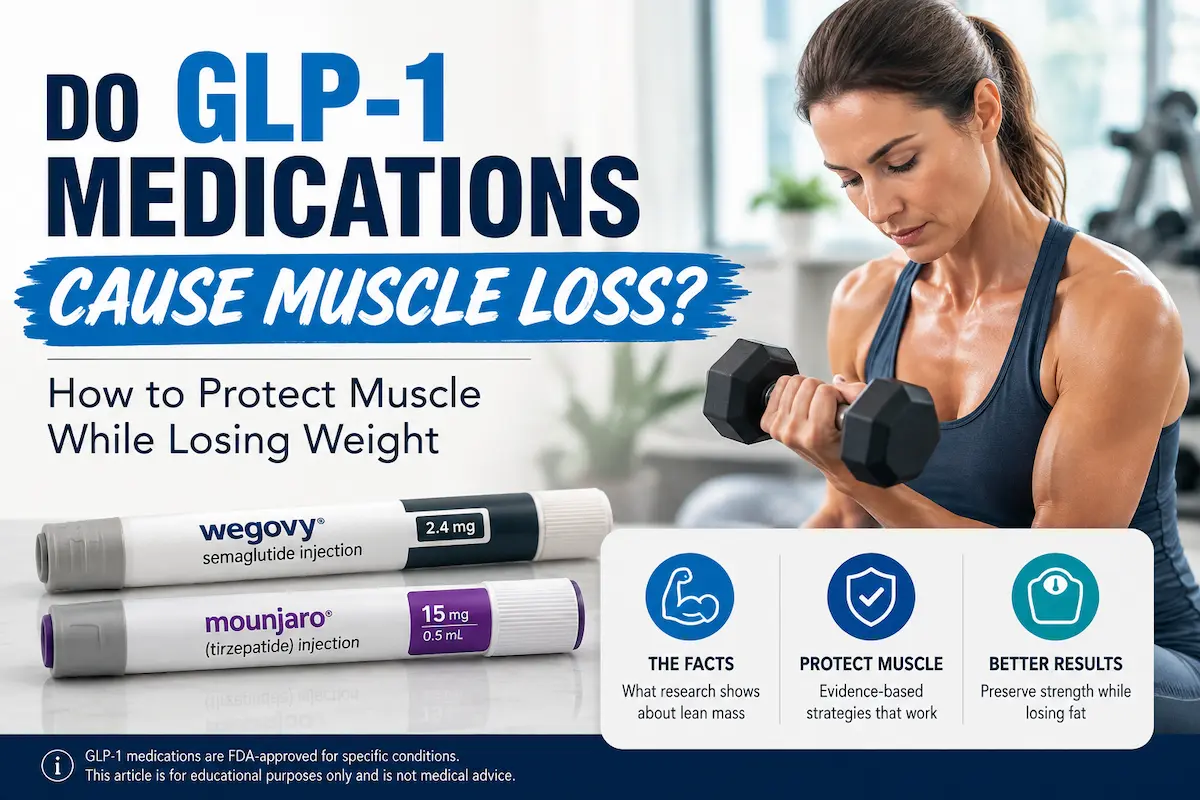
Search for GLP-1 muscle loss, Ozempic muscle loss, Wegovy muscle loss, Mounjaro muscle loss or Zepbound muscle loss and you will quickly find alarming headlines. The underlying issue is real—but the most useful answer is more nuanced.
People commonly lose both fat and some lean tissue during substantial weight loss, whether weight loss comes from lifestyle changes or medication. The key questions are how much lean tissue is lost, whether skeletal muscle strength and function are preserved, and what can be done to improve the quality of the weight loss.
Lean mass is not the same thing as skeletal muscle
When a study reports a reduction in lean mass, the number does not represent pure muscle tissue. Lean mass includes skeletal muscle but also other non-fat tissue and water.
The body's stored adipose tissue.
A broad measurement of non-fat tissue.
Skeletal muscle specifically—one component of lean mass.
Strength and physical performance matter in addition to mass.
So “25% of lost weight was lean mass” is not the same as saying “25% was muscle.”
What does current research say about GLP-1 muscle loss?
The evidence is more nuanced than either “GLP-1s destroy muscle” or “there is nothing to worry about.”
A 2026 meta-analysis of 20 randomized trials involving 15,782 participants found that lean mass represented about 25% to 39% of total weight lost with incretin therapies, depending on the medicine. Lifestyle-only weight loss had a comparable proportional lean-mass reduction overall, while lifestyle intervention that included resistance training had the most favorable lean-mass profile.
Another 2026 study concluded that people with obesity using GLP-1 medicines improved body composition without a negative effect on strength in the human data examined.
Does semaglutide cause muscle loss?
Semaglutide—the active ingredient in products including Wegovy and Ozempic—can reduce both fat mass and lean mass as body weight decreases.
Current FDA prescribing information for Wegovy states that semaglutide lowers body weight with greater fat-mass loss than lean-mass loss.
The STEP 1 DXA substudy also found substantial fat-mass reduction alongside a smaller reduction in lean soft tissue. Exact percentages vary across analyses because study populations, duration and measurement methods differ.
Does tirzepatide cause muscle loss?
Tirzepatide—the active ingredient in Mounjaro and Zepbound—also reduces both fat mass and lean mass during substantial weight loss.
In the SURMOUNT-1 body-composition substudy, approximately 75% of the weight lost with tirzepatide was fat mass and about 25% was lean mass. Overall body composition improved.
| Question | What the evidence suggests |
|---|---|
| Does weight loss include lean mass? | Yes. Both semaglutide and tirzepatide studies report some lean-tissue reduction. |
| Is most lost weight fat? | Generally yes in major body-composition studies. |
| Does lean-mass loss equal muscle loss? | No. Lean mass includes more than skeletal muscle. |
| Does strength necessarily fall? | No. Available evidence does not show a proportional decline in strength. |
Is some lean-mass loss normal during weight loss?
Yes. Meaningful weight loss commonly includes some non-fat tissue along with fat. This is not unique to GLP-1 medications.
The more useful question is the quality of the weight loss: how much comes from fat, how much lean tissue is retained, and whether strength, mobility and overall health are maintained.
Who should be especially careful about preserving muscle?
- Older adults
- People who already have low muscle mass or weakness
- People with sarcopenic obesity
- People with type 2 diabetes who also have impaired strength or function
- People eating very little because of reduced appetite or gastrointestinal side effects
- Anyone losing weight rapidly without resistance exercise
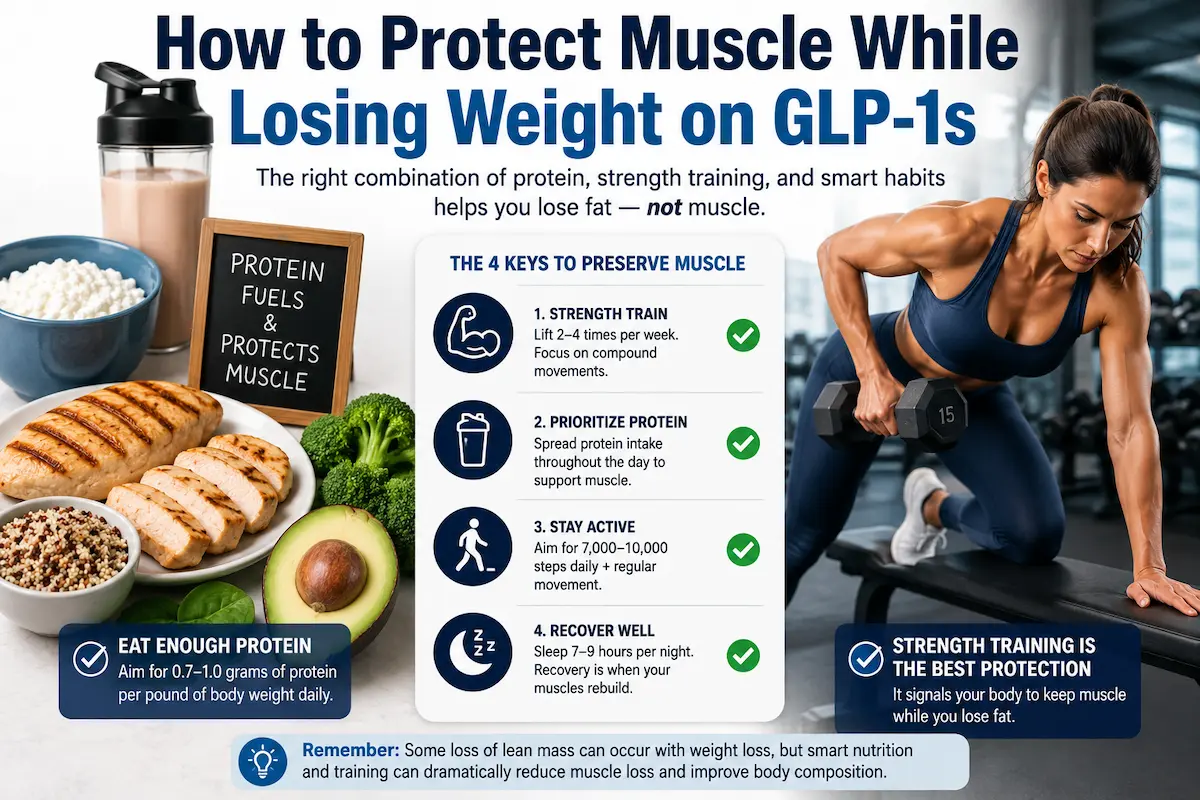
How to help protect muscle while losing weight on a GLP-1
Progressive resistance exercise gives your body a reason to retain muscle and has strong evidence for improving lean-mass preservation during weight loss.
Appetite suppression can make eating less easy, but very low intake can make it harder to meet protein, vitamin and mineral needs.
Adequate dietary protein provides amino acids needed to maintain and repair muscle. Individual needs vary.
Walking and other daily movement help preserve function and complement strength training.
Sleep and recovery matter because training is the stimulus; adaptation occurs between sessions.
Strength, function, energy, waist circumference and nutrition can provide a fuller picture than the scale alone.
How much protein should you eat while taking a GLP-1?
There is no single protein target that is appropriate for every person using semaglutide, tirzepatide or another incretin-based medicine.
Expert recommendations emphasize adequate protein and micronutrient intake. The right amount depends on age, body size, calorie intake, activity, kidney function and other medical issues.
Practical ways to support protein intake when appetite is low
- Include a protein source at each meal.
- Choose nutrient-dense foods when portions are smaller.
- Spread protein intake across the day.
- Discuss shakes or supplemental protein with a clinician or registered dietitian if ordinary food intake is difficult.
- Get individualized guidance before adopting a very high-protein diet if you have kidney disease or another relevant condition.
Resistance training may be the biggest controllable lever
A 2026 meta-analysis found that lifestyle interventions incorporating resistance training had a lower proportion of weight loss coming from lean mass than lifestyle treatment alone. Expert guidance on incretin therapy also emphasizes resistance training to help preserve muscle mass and function.
You do not need to become a bodybuilder. Appropriate training can include machines, dumbbells, resistance bands or body-weight movements. The right program depends on your current strength, joint health, balance and medical history.
What about rapid weight loss?
Faster or larger weight loss can increase the absolute amount of lean tissue lost because more total body mass is changing. Maintaining adequate nutrition and resistance exercise becomes especially important when GLP-1 therapy produces a large response.
Do not accelerate medication dosing or severely restrict calories to force faster results. Follow the prescribed titration schedule and discuss the pace of weight loss with your clinician.
Comparing prescription GLP-1 treatment with a non-prescription option?
Some people researching GLP-1 medications eventually compare prescription treatment with lower-cost, non-injection supplements such as Ignyt triGLP.
triGLP is a dietary supplement—not semaglutide, tirzepatide or an FDA-approved GLP-1 receptor agonist. It should not be presented as medically equivalent to Wegovy, Ozempic, Mounjaro or Zepbound.
If cost, injections or access are why you are comparing options, our full review explains triGLP's positioning, ingredients and pricing separately from prescription therapy.
Read the Complete triGLP Review →GLP-1 muscle-loss FAQ
Do GLP-1 medications cause muscle loss?
Does Wegovy cause muscle loss?
Does Mounjaro or Zepbound cause muscle loss?
How can I protect muscle while using a GLP-1 medication?
Is lean mass the same as muscle?
Research and official sources
- FDA — 2026 semaglutide prescribing information
- SURMOUNT-1 DXA substudy — tirzepatide body composition
- 2026 meta-analysis — incretin therapy versus lifestyle interventions
- 2026 study — GLP-1 medicines, body composition and strength
- Expert review — minimizing muscle loss during incretin-based obesity treatment
- New England Journal of Medicine — GLP-1 receptor agonists review
Continue learning
The goal is better-quality weight loss—not just a lower number on the scale
Preserving strength and function deserves a place beside weight, waist circumference and metabolic health when evaluating long-term progress.
Explore the GLP-1 Learning Center →