
The phrase “food noise” has moved rapidly from social media and patient conversations into scientific research. For some people, it describes a constant background stream of thoughts about food: what to eat, when to eat, what is in the kitchen, what sounds good next, or whether to give in to a craving.
That experience is different from simply enjoying food or becoming hungry before dinner. Researchers are now trying to understand whether food noise represents a distinct measurable phenomenon, how it overlaps with appetite and cravings, and why some people report substantial changes after starting medications such as semaglutide or tirzepatide.
What is food noise?
There is no single official clinical definition. In everyday use, food noise generally refers to recurring thoughts, urges and mental preoccupation involving food that feel difficult to ignore.
Researchers at Penn State reported in 2026 that social-media discussions commonly describe food noise as endless or looping thoughts about eating. Their work emphasizes that the term is widely used while its scientific definition and boundaries are still developing.
What can food noise feel like?
- Thinking about what to eat next shortly after a meal.
- Repeatedly thinking about food in the kitchen or pantry.
- Feeling pulled toward a specific food despite not being physically hungry.
- Planning meals and snacks far in advance because food occupies substantial mental attention.
- Finding it difficult to concentrate because cravings repeatedly interrupt other thoughts.
Occasionally thinking about food is normal. Food noise generally refers to the frequency, persistence or intrusiveness of the thoughts.
Food noise vs. hunger: are they the same?
No. They can overlap, but they are not necessarily identical.
| Physical hunger | “Food noise” |
|---|---|
| Often increases as time passes after eating | Can occur relatively soon after eating |
| May include physical sensations | Often described as thoughts, urges or mental preoccupation |
| A range of foods may satisfy the need | May focus strongly on a particular food or reward |
| Usually decreases after sufficient food | Some people report continued food thoughts despite feeling full |
Do GLP-1 medications reduce food noise?
Some patients report that they do. That is one reason the phrase has become closely associated with Ozempic, Wegovy, Mounjaro, Zepbound and related medications.
In a 2026 Stanford study based on interviews with 30 adults using GLP-1 receptor agonist medications, reduced food noise was a prominent part of some participants’ experiences. A separate 2026 retrospective survey of people using injectable semaglutide for weight management also examined self-reported changes in food noise.
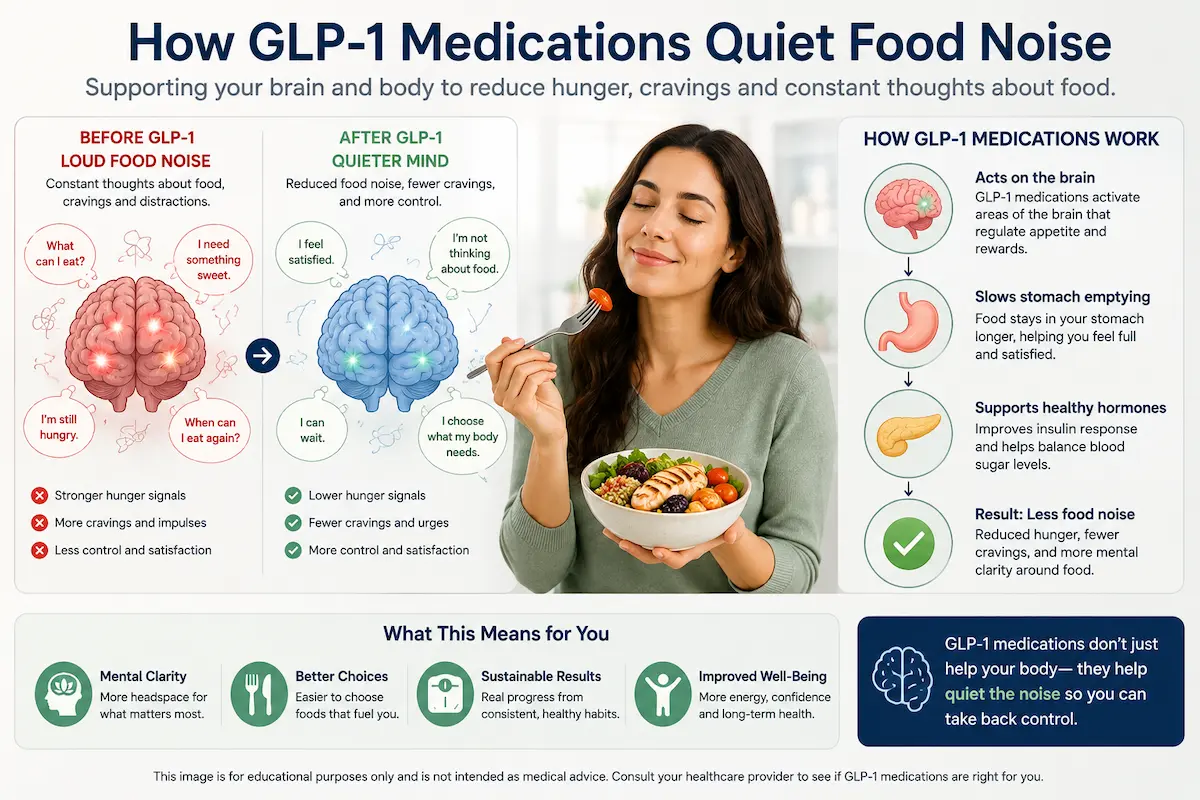
Why might GLP-1 medications change hunger and food thoughts?
Appetite signaling
GLP-1 receptors are involved in pathways related to appetite and satiety. By influencing these pathways, GLP-1 medicines can reduce hunger and food intake.
Calorie intake
Current FDA prescribing information for semaglutide states that semaglutide decreases calorie intake and that the effect is likely mediated through appetite.
Gastric emptying
Semaglutide also delays gastric emptying. This is one component of a broader appetite-regulation mechanism.
Cravings and reward
Researchers are studying how GLP-1-based treatments affect food reward, cravings and eating behavior. Patient reports suggest these changes may contribute to what people experience as quieter food noise, although the precise mechanisms behind the subjective phenomenon are not fully established.
What does the latest research say?
Stanford: real-world GLP-1 experience
Stanford researchers published qualitative work in 2026 examining how adults experience GLP-1 treatment. Reduced food noise emerged as an important theme for some participants, alongside side effects, stigma and access barriers.
Penn State: defining the phrase
Penn State researchers examined how people discuss food noise on social media. Their work highlights both the usefulness and limitations of the phrase: many people recognize the experience, but scientists still need standardized definitions and validated measurement tools.
The INFORM survey
A 2026 study in Advances in Therapy retrospectively assessed changes in food noise after people began injectable semaglutide for weight management, adding quantitative evidence to a topic previously dominated by anecdotes.
Can food noise come back?
Individual responses can change over time, and appetite may increase after GLP-1 therapy is discontinued. Some people also report fluctuations in cravings or food thoughts during ongoing treatment. Do not change a prescription dose on your own; discuss meaningful changes with the clinician managing your treatment.
Read more in What Happens When You Stop GLP-1 Medications?
Can you reduce food noise without a GLP-1 medication?
Because food noise is not yet a clearly defined diagnosis, there is no single proven treatment specifically for it. Persistent food thoughts may be influenced by physical hunger, eating patterns, stress, sleep, environmental cues, restrictive dieting and psychological factors.
- Eat sufficiently and consistently rather than repeatedly becoming extremely hungry.
- Include adequate protein, fiber and nutrient-dense foods in a balanced diet.
- Identify environmental cues that repeatedly trigger eating.
- Address sleep and stress when either contributes to cravings.
- Consider a registered dietitian when eating patterns are difficult to manage.
- Seek mental-health support when food thoughts are distressing, compulsive or associated with disordered eating.
Looking at non-prescription options such as triGLP?
Ignyt triGLP belongs in the supplement category—not the prescription GLP-1 drug category. It is not semaglutide, tirzepatide, Ozempic, Wegovy, Mounjaro or Zepbound and should not be represented as producing the same pharmacological effects.
If your goal is to understand what triGLP contains, how it is marketed, its cost and how it compares conceptually with prescription options, our separate review addresses those questions.
Read Our Complete triGLP Review →